Your smile is one of the first things people notice about you, and if you’ve been considering a dental makeover, you’ve probably come across two popular treatments: dental veneers and crowns. While both are designed to enhance the appearance and functionality of your teeth, they serve different purposes and are suited to different dental needs. Understanding the key differences between dental veneers and crowns can help you decide which option is best for you, whether you’re looking to improve your smile’s aesthetics or restore a damaged tooth.
What Are Dental Veneers?
Dental veneers are thin, custom-made shells that are bonded to the front surface of your teeth. These shells are designed primarily for cosmetic improvements, addressing issues like discoloration, chips, gaps, or misshapen teeth. Veneers are typically made of porcelain or composite resin, with porcelain being the more durable and natural-looking option.
The main purpose of veneers is to improve the appearance of your smile. If you have relatively healthy teeth that are slightly discolored, worn, or uneven, veneers can provide a quick, non-invasive solution to enhance their appearance.
Common Uses for Veneers
Veneers are ideal for minor cosmetic improvements. If you’re looking to enhance the appearance of your front teeth, veneers may be the perfect option for you. Some of the common reasons people choose veneers include:
- Discoloration: If your teeth are stained or discolored and whitening treatments don’t work, veneers can provide a more permanent solution.
- Minor Chips or Cracks: Veneers can hide small imperfections like chips or cracks on the surface of your teeth.
- Gaps Between Teeth: Veneers can be used to fill in minor gaps or spaces between your teeth, giving you a more even, symmetrical smile.
- Shape and Length: Veneers can also be used to correct the shape or length of your teeth, making them more uniform with the rest of your smile.
Materials and Types of Veneers
- Porcelain Veneers: These are the most popular choice for veneers due to their natural appearance. They are highly durable, stain-resistant, and provide a long-lasting, aesthetic solution for improving your smile.
- Composite Veneers: A more affordable alternative, composite veneers are made from a resin material and are generally less durable than porcelain. They may require more maintenance and have a shorter lifespan, but they still offer a great cosmetic solution at a lower price point.
What Are Dental Crowns?
A dental crown is a full cap that covers the entire tooth. Crowns are used when a tooth has been significantly damaged or decayed and needs to be restored to its original shape and function. Unlike veneers, which only cover the front surface of the tooth, crowns encase the entire tooth, providing a stronger and more protective restoration.
Crowns are ideal for both cosmetic and restorative purposes. They can be used to strengthen a tooth that has undergone a root canal, restore a broken or fractured tooth, or cover a large filling. Dental crowns are also used to address significant tooth decay that cannot be fixed with a filling alone.
Common Uses for Crowns
Crowns are typically recommended when the tooth structure is too compromised for veneers to be effective. Some of the most common reasons people opt for dental crowns include:
- Severe Decay: When a tooth is extensively decayed, a crown can cover the entire tooth and restore its function.
- Post-Root Canal: After a root canal treatment, a tooth can become fragile and vulnerable to further damage. A crown helps to protect the tooth and restore its strength.
- Fractures or Breaks: Crowns are an excellent solution for repairing teeth that are cracked or broken, especially when the damage is too severe for a veneer.
- Large Fillings: If you have a large filling that compromises the integrity of the tooth, a crown can provide added strength and stability.
Materials and Types of Crowns
- Porcelain Crowns: Porcelain crowns are a great choice for front teeth as they offer a natural, aesthetic appearance. They are durable and blend well with your existing teeth.
- Metal Crowns: Metal crowns are often used for back teeth due to their durability. These crowns are less noticeable but are ideal for restoring strength to molars or premolars.
- Porcelain-Fused-to-Metal Crowns: These crowns combine the aesthetic appeal of porcelain with the strength of metal, making them a good option for both back and front teeth.
- Zirconia Crowns: Zirconia is a newer material that is both durable and natural-looking. It’s often used for both aesthetic and functional purposes.
The Key Differences Between Veneers and Crowns
Coverage and Functionality
- Veneers: Veneers only cover the front surface of the tooth, improving the appearance of your smile without addressing underlying structural issues. They are primarily cosmetic and provide a solution for teeth that are aesthetically imperfect but not structurally damaged.
- Crowns: Crowns, on the other hand, cover the entire tooth, providing both cosmetic enhancement and structural restoration. Crowns are often necessary when a tooth is weakened, broken, or decayed beyond repair with just a filling.
Damage and Enamel Removal
- Veneers: The process of applying veneers involves minimal enamel removal from the front of the tooth. This makes the procedure less invasive and allows for the preservation of most of your natural tooth structure.
- Crowns: To place a crown, more extensive enamel removal is required. The entire tooth needs to be reshaped so that the crown can fit over it securely. This means that crowns are generally considered more invasive than veneers.
Longevity and Durability
- Veneers: Veneers are typically designed to last between 10 to 15 years, depending on the material (porcelain lasts longer than composite) and how well they are cared for. However, they are more prone to chipping or staining, especially if you have habits like grinding your teeth or eating stain-causing foods.
- Crowns: Crowns are incredibly durable and can last anywhere from 10 to 30 years, depending on the material. Metal crowns tend to last longer than porcelain ones, but porcelain crowns are still strong enough for most patients.
| Feature | Dental Veneer | Dental Crown |
| Coverage | Front surface only | Entire tooth (360 degrees) |
| Tooth Preparation | Minimal (approx. 0.5mm) | Significant (approx. 2mm) |
| Primary Goal | Cosmetic / Appearance | Structural / Strength |
| Best For | Stains, small gaps, minor chips | Large cavities, cracks, root canals |
| Thickness | Very thin (like a contact lens) | Thicker (2mm+ for strength) |
Procedure: How Veneers and Crowns Are Applied
Dental Veneer Procedure
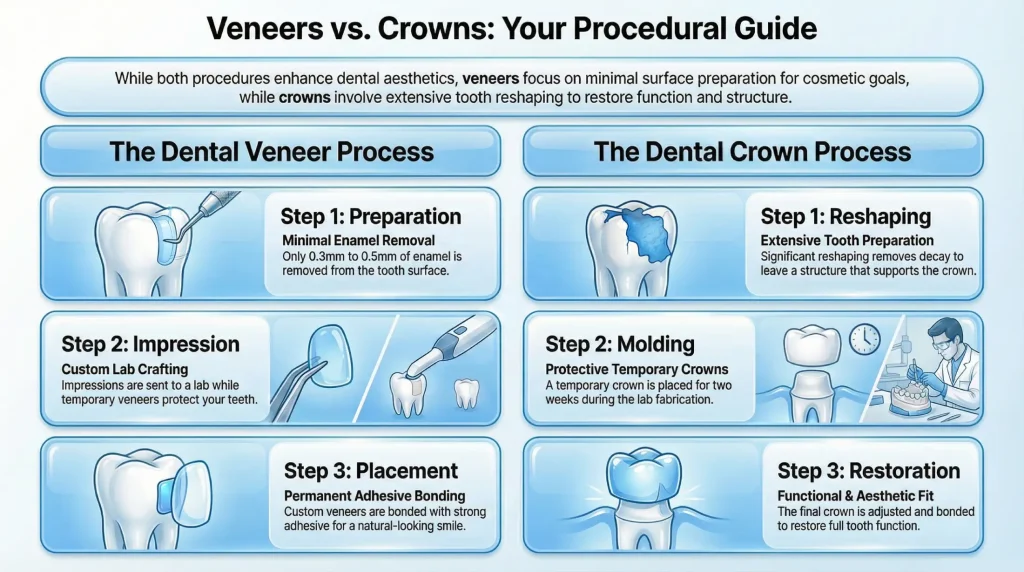
The process of getting dental veneers is relatively simple and requires only a couple of visits to the dentist. Here’s how the procedure typically works:
- Step 1: Consultation and Tooth Preparation
During your first visit, your dentist will evaluate your teeth and discuss your cosmetic goals. If veneers are a good option for you, the dentist will lightly prepare the front of your teeth by removing a small amount of enamel (about 0.3 to 0.5mm). This is essential to ensure that the veneers fit properly and align with your natural tooth structure. - Step 2: Impressions and Temporary Veneers
After preparing the tooth, the dentist will take an impression of your teeth. This impression is sent to a lab, where your custom veneers will be crafted. In the meantime, a temporary veneer may be placed to protect your tooth until the permanent veneers are ready. - Step 3: Permanent Placement
Once the veneers are ready (typically within 1-2 weeks), you’ll return to the dentist’s office. The dentist will carefully bond the veneers to your teeth using a strong adhesive. The final result is a natural-looking smile that enhances your teeth’s appearance.
Dental Crown Procedure
Getting a dental crown involves a more extensive process than veneers due to the need for reshaping the tooth. Here’s how the procedure for dental crowns generally works:
- Step 1: Consultation and Tooth Preparation
The dentist will begin by examining the affected tooth and preparing it for the crown. Unlike veneers, which only require minimal enamel removal, crowns necessitate significant reshaping of the tooth. The dentist will remove the damaged or decayed portion of the tooth, leaving enough structure to support the crown. - Step 2: Molding and Temporary Crown
After reshaping the tooth, the dentist will take an impression of the prepared tooth. This will be sent to a lab to create your custom crown. A temporary crown will be placed over the tooth to protect it while the permanent crown is being made (which typically takes about 2 weeks). - Step 3: Permanent Crown Placement
When your permanent crown is ready, you’ll return to the dentist’s office for the final placement. The dentist will check the fit, make any necessary adjustments, and then bond the crown to the tooth. The result is a restored tooth that is both functional and aesthetic.
Pros and Cons: Which Is Better for Your Smile?
Advantages of Dental Veneers
- Natural Appearance: Veneers are incredibly natural-looking, providing an enhanced smile that is virtually indistinguishable from real teeth. The porcelain material mimics the translucency of natural tooth enamel, making your smile appear authentic.
- Minimal Tooth Preparation: The process for veneers is less invasive than crowns since only a thin layer of enamel is removed. This allows for the preservation of the majority of your natural tooth structure.
- Stain Resistance: Porcelain veneers are highly resistant to staining, so your smile will remain bright and white even after years of use.
Disadvantages of Dental Veneers
- Fragility: While porcelain veneers are durable, they are still more fragile than crowns. They can chip or crack if you accidentally bite something hard or if you grind your teeth.
- Limited Use for Severe Damage: Veneers are not suitable for repairing severely damaged teeth. If your teeth are cracked, decayed, or have extensive fillings, veneers may not be the best option.
- Irreversibility: Once the enamel is removed for veneer placement, it cannot be restored. This makes veneers an irreversible treatment.
Advantages of Dental Crowns
- Full Protection: Crowns provide full coverage and protection for teeth that are severely damaged, decayed, or weakened. They help restore both the strength and function of a tooth.
- Long-Lasting Durability: Crowns are incredibly durable and can last anywhere from 10 to 30 years, depending on the material used. Metal crowns, for instance, are often the most durable, especially for back teeth.
- Versatility: Crowns are suitable for both cosmetic and functional improvements. Whether you need a crown after a root canal or to restore a broken tooth, they are versatile enough to meet a variety of needs.
Disadvantages of Dental Crowns
- More Tooth Removal: Getting a crown requires more tooth structure to be removed compared to veneers. This makes the process more invasive, and in some cases, it could weaken the natural tooth over time.
- Higher Cost: Dental crowns are generally more expensive than veneers due to the additional material and labor required to create a custom crown. Additionally, crowns often require multiple visits, increasing the overall cost
. - Less Aesthetic for Front Teeth: Although porcelain crowns are available, metal crowns are often used for back teeth. Metal crowns can be noticeable when placed on the front teeth, which may not be ideal for people who are looking for a natural look.
Cost: How Much Do Veneers and Crowns Cost?
Veneers Cost Breakdown
The cost of veneers can vary widely based on the material used and the location of the dental clinic. Here’s a general breakdown:
- Porcelain Veneers: $1,000 – $2,500 per tooth
- Composite Veneers: $500 – $1,500 per tooth
While porcelain veneers are more expensive, they offer greater durability and a more natural appearance. Composite veneers are more affordable but may require more maintenance and have a shorter lifespan.
It’s important to note that veneers are generally considered a cosmetic treatment, so they are often not covered by insurance.
Crowns Cost Breakdown
The cost of dental crowns also depends on the material and location, but here’s an estimate:
- Porcelain Crowns: $1,000 – $2,500 per tooth
- Metal Crowns: $800 – $3,000 per tooth
- Porcelain-Fused-to-Metal Crowns: $1,000 – $2,500 per tooth
- Zirconia Crowns: $1,500 – $2,500 per tooth
Since crowns are typically used for restorative purposes, they may be covered by insurance, especially if the crown is needed due to decay, fracture, or root canal treatment.
Insurance and Financing Options
In many cases, dental insurance may cover part of the cost of crowns, especially if they’re used for structural purposes. However, veneers are often considered a cosmetic treatment, which means they are not typically covered by insurance. It’s always a good idea to check with your insurance provider to see what treatments are covered and inquire about financing options.
Choosing a Veneer: When Aesthetics Take Priority
We usually recommend a veneer when the underlying tooth is still strong and healthy but has surface-level flaws that bother you. Since a veneer only replaces the front face of the tooth, it is the best way to fix problems that are purely visual. For our patients in Burwood who are happy with the strength of their bite but unhappy with how their smile looks in photos, veneers offer a way to get a bright, even result without losing much enamel. It is the preferred choice for creating a Hollywood smile while keeping your natural tooth structure intact. If your goal is to fix surface-level stains or small gaps, high-quality dental veneers offer a conservative way to transform your look without major surgery.
Choose a Veneer If:
- Permanent Staining: You have internal discolouration from old medications or trauma that professional whitening cannot fix.
- Minor Chips or Wear: The edges of your teeth look jagged or worn down from age, but the tooth is not cracked.
- Diastema (Gaps): You have small spaces between your front teeth that you want to close without using braces.
- Slightly Crooked Teeth: You want to fix minor tooth rotations to make the smile look more uniform.
Choosing a Crown: When Strength is the Goal
A dental crown becomes necessary when a tooth has lost its ability to support itself. If you try to put a thin veneer on a tooth that is mostly made of filling material or has a large crack, the veneer will likely pop off or the tooth will break underneath it. A crown acts like a protective brace that holds the remaining tooth together. At Burwood Diamond Dental, we use crowns to save teeth that might otherwise need to be pulled out, ensuring you can continue to eat and chew without pain or fear of a sudden fracture. Crowns are often the best solution for teeth weakened by significant decay; however, understanding how to prevent cavities in the first place is the best way to avoid needing major restorations.
Choose a Crown If:
- Large Existing Fillings: The tooth has more filling material than natural enamel, making it brittle.
- Cracked or Broken Teeth: You have a fracture that goes deep into the tooth, causing pain when you bite down.
- Post-Root Canal Treatment: After a root canal, a tooth becomes dry and fragile; a crown is essential to prevent it from shattering.
- Significant Decay: The cavity was so large that there wasn’t enough healthy enamel left to bond a veneer to.
Care and Maintenance: How to Make Your Veneers and Crowns Last
Caring for Veneers
While dental veneers are highly durable, they still require some care to maintain their aesthetic appeal and functionality. Here are some essential tips to help you keep your veneers in great shape:
- Avoid Hard Foods: Porcelain veneers are durable, but they can still chip or crack if you bite down on hard objects like ice or hard candy. It’s best to avoid chewing on anything too hard or sticky.
- Good Oral Hygiene: Just like your natural teeth, veneers need regular brushing and flossing. Use a non-abrasive toothpaste to avoid scratching the surface of the veneers. Regular dental cleanings will also help maintain the finish.
- Wear a Mouthguard for Teeth Grinding: If you grind your teeth at night, you should consider wearing a mouthguard. Teeth grinding can put excess pressure on your veneers and lead to damage over time.
- Regular Check-Ups: While veneers don’t require special maintenance, it’s important to visit your dentist regular checkups to ensure that they remain in good condition and to check for any underlying issues, such as decay in the exposed tooth.
Caring for Crowns
Dental crowns are generally more durable than veneers, but they still require proper care to ensure they last for years. Here are some tips to keep your crown in great condition:
- Avoid Chewing Hard Objects: As with veneers, it’s essential to avoid biting down on hard foods, such as hard candies, ice, or nails. This can crack or loosen the crown.
- Maintain Oral Hygiene: Regular brushing and flossing are essential to prevent decay or gum disease around the crown. Ensure that you clean around the edges of the crown to avoid buildup of plaque or food particles that can lead to tooth decay.
- Avoid Sticky Foods: Sticky foods like caramel and taffy can pull at the edges of the crown, making it loose over time. Be cautious with foods that could potentially dislodge the crown.
- Avoid Grinding Your Teeth: If you grind your teeth (bruxism), consider wearing a night guard to protect your crown from excessive wear or damage.
Long-Term Care
Both veneers and crowns are durable treatments, but their longevity will depend on your care and maintenance. By following these tips, you can maximize their lifespan and keep your smile looking great for years to come. Regular visits to your dentist for professional check-ups and cleanings will also help ensure your veneers and crowns remain in optimal condition.
Frequently Asked Questions (FAQs)
1. Which Is Better: Veneers or Crowns?
Both veneers and crowns are great options, but which one is best for you depends on your specific needs. If you have healthy teeth that just need a cosmetic enhancement, veneers are likely the better choice. On the other hand, if your teeth are severely damaged, decayed, or require structural support (like after a root canal), crowns will be the better option. It’s essential to consult with your dentist to determine which solution aligns with your goals.
2. How Long Do Veneers and Crowns Last?
- Veneers: Porcelain veneers typically last 10-15 years, while composite veneers may last 5-7 years. The lifespan of veneers depends on factors such as your oral hygiene, diet, and whether you grind your teeth.
- Crowns: Crowns are more durable, with porcelain crowns lasting 10-15 years, while metal crowns can last 20-30 years or longer. Crowns are ideal for long-term use, especially when used to restore teeth.
3. Do Veneers or Crowns Stain?
Porcelain veneers are highly resistant to staining, but over time, they may become discolored if not properly cared for. Composite veneers are more susceptible to staining. On the other hand, porcelain and zirconia crowns are stain-resistant, but metal crowns may discolor at the gum line. Good oral hygiene will help minimize staining for both treatments.
4. Is the Dental Crown Procedure Painful?
The dental crown procedure is typically not painful, as your dentist will use local anesthesia to numb the area around the tooth. You may experience some discomfort or sensitivity after the procedure, but this should subside within a few days.
5. Can I Get a Veneer Over a Crown?
In some cases, it is possible to place a veneer over a crown if the crown is intact and in good condition. However, this depends on your specific dental needs, so it’s important to consult with your dentist to determine if this is a viable option for you.
Why Choose Burwood Diamond Dental for Your Restoration?
At Burwood Diamond Dental, we don’t believe in upselling one treatment over another. Our team, led by Drs Khoshamadi, Gomez, and Ramon, focuses on conservative dentistry. If a tooth can be saved and beautified with a thin veneer, we will always choose that to save your natural enamel. If the tooth is at risk of breaking, we will be honest about the need for a crown to protect your health. Our clinic is equipped with the latest iTero digital scanners, meaning no messy impressions and a much more comfortable experience.
Conclusion: Making the Final Decision
Choosing between a dental veneer vs crown really comes down to one simple question: Does your tooth need a new look, or does it need a new suit of armor?
- If your tooth is strong but you want to change its color or shape, A veneer is your best friend. It acts like a high-tech mask that hides stains, closes gaps, and fixes minor chips while keeping almost all of your natural teeth intact.
- If your tooth is cracked, decayed, or has a large filling, A crown is the only way to ensure it stays in your mouth for the long haul. It provides a full 360-degree shield that holds a weak tooth together, protecting it from the heavy pressure of everyday chewing.
Why the Right Choice Matters
At Burwood Diamond Dental, we believe in Preservation First. Our goal is to save as much of your natural enamel as possible while ensuring your smile is healthy. If we can achieve your dream look with a thin veneer, we will. However, if a crown is necessary to prevent a tooth from breaking, we’ll provide a porcelain option that looks just as natural as a veneer. Ultimately, your smile is an investment in your confidence and your health. By choosing the restoration that matches your tooth’s structural needs, you ensure a result that doesn’t just look great on day one, but stays strong for the next decade.