By Dr Mohsen Khoshamadi, DDS (Tehran University, 2002), principal dentist at Burwood Diamond Dental. Registered to practise in Australia after passing the Australian Dental Council examination in 2009. Over two decades of clinical experience, with a special interest in dental implants.
Reviewed September 2026
Implants fail in about 6 smokers out of 100, and about 3 non-smokers
In the largest pooled analysis we have, implants placed in smokers failed 6.35 per cent of the time. In non-smokers, 3.18 per cent. That is 1,259 failures out of 19,836 implants in one group and 1,923 out of 60,464 in the other, across 107 publications reviewed by Chrcanovic, Albrektsson and Wennerberg in the Journal of Dentistry in 2015.
Expressed as a ratio, smoking carried 2.23 times the failure risk (95 per cent confidence interval 1.96 to 2.53).
I quote both percentages on purpose, because the second one goes missing on most pages about this. Roughly 94 implants in every 100 placed in smokers were still working. Smoking doesn’t make implant treatment futile; it shortens odds that are still in your favour, and it changes what a sensible plan looks like.
The rest of what that review found:
| What was measured | Pooled result for smokers | How to read it |
| Implant failure | Risk ratio 2.23 (95% CI 1.96 to 2.53), P < 0.00001 | About double the failure risk. The interval is narrow, so this one is firm |
| Post-operative infection | Risk ratio 2.01 (95% CI 1.09 to 3.72), P = 0.03 | About double, but the wide interval means the true size is less certain |
| Marginal bone loss | Mean difference 0.32 mm (95% CI 0.21 to 0.43) | A third of a millimetre more bone lost around the implant over the study periods |
| Failure, upper jaw only | Risk ratio 2.22 (95% CI 1.63 to 3.01) | The interval sits entirely above 1, so the upper jaw finding holds |
| Failure, lower jaw only | Risk ratio 2.61 (95% CI 0.92 to 7.39) | The interval crosses 1. This result did not clear the statistical bar |
The screw does not heal. Your jaw does
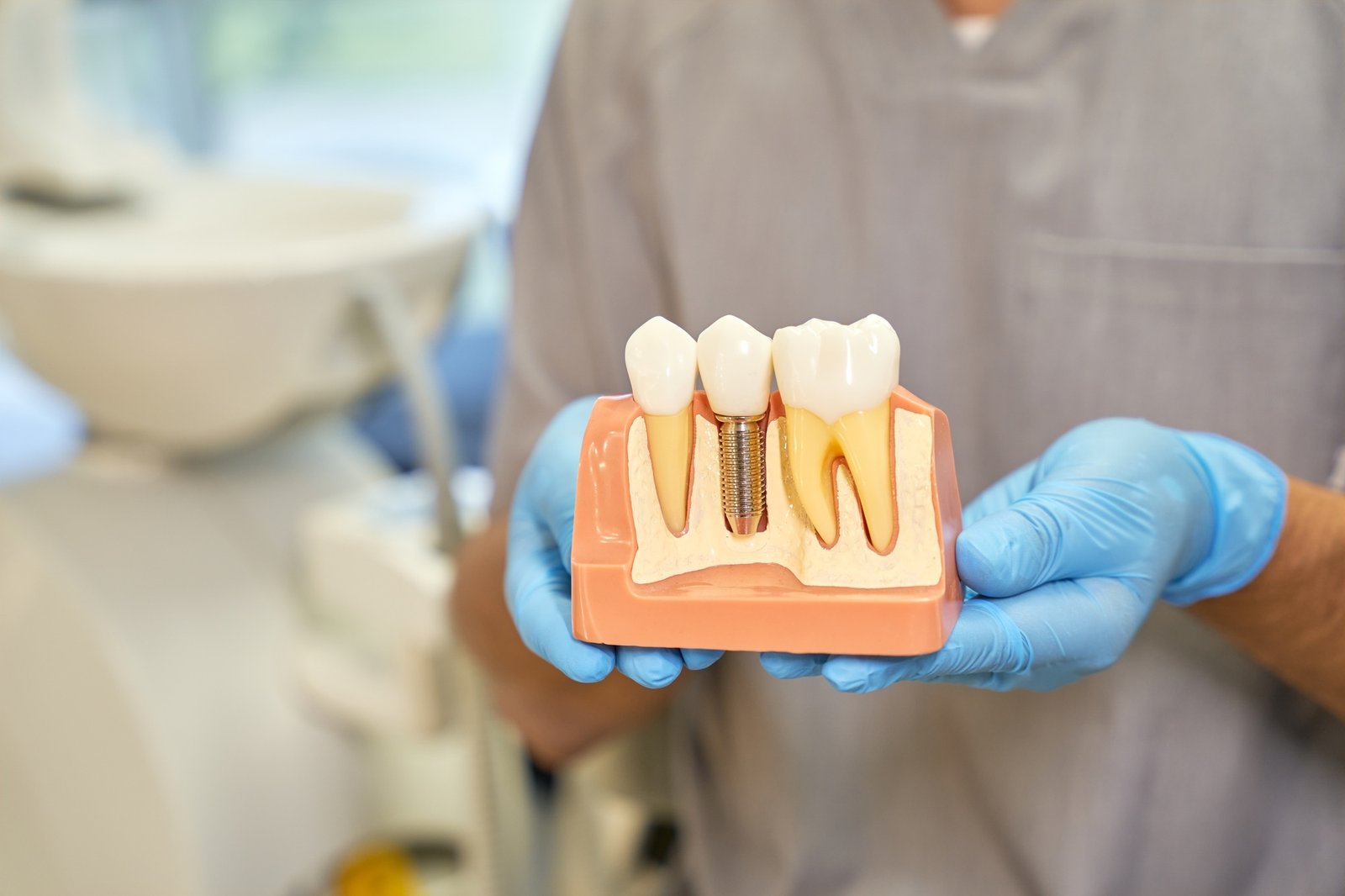
An implant is a titanium screw. It has no biology of its own. All the work is done by the bone and gum around it, and that work is called osseointegration: living bone grows directly onto the metal surface until the two cannot be separated without breaking something. It takes weeks to months, and it runs on blood supply. Everything below follows from that one fact.
Smoking interferes at four separate points in that supply chain.
Nicotine is a vasoconstrictor. It tightens the small vessels, including the ones feeding the cut edge of gum and the walls of the freshly drilled socket, so less blood arrives at the tissue that needs it most.
Carbon monoxide then reduces what that blood carries. It binds to haemoglobin far more readily than oxygen does, so the red cells that do reach the site turn up part loaded. Bone formation is oxygen-hungry; it doesn’t speed up to compensate.
Neutrophils, the white cells that arrive first and clear bacteria from a fresh wound, move more slowly and engulf less efficiently in smokers. So do the fibroblasts that build the collar of soft tissue sealing the implant off from the mouth, and that seal is what keeps bacteria out for as long as the implant is in service.
And the smoke itself is hot and drying, passing over a healing surgical wound several times a day.
So you’re asking a wound to heal with less blood arriving, less oxygen in the blood that does arrive, a slower clean-up crew and a physical insult on top. The tobacco isn’t attacking the titanium; it’s slowing the biology that has to happen around it. That is why the wait between placing an implant and fitting the crown is the longest stage of implant treatment, and why I’m reluctant to shorten it for a smoker.
Where this evidence is softer than most pages admit
Almost every page on this subject says “smokers have twice the failure rate” and stops there. That is roughly right, and incomplete in two ways that matter if you are the person deciding.
The upper jaw result held. The lower jaw result did not. In the maxilla alone the risk ratio was 2.22, interval 1.63 to 3.01, comfortably above 1. In the mandible alone the point estimate was higher, 2.61, but the interval ran from 0.92 to 7.39. Because that range includes 1, and 1 means no difference at all, the lower jaw analysis did not clear the conventional statistical threshold. A spread that wide usually means too few lower jaw failures were pooled to settle the question. It isn’t a finding that smoking is harmless in the mandible; it’s a finding that we can’t yet say how much worse it is. I still treat a lower jaw smoker as a raised risk, because the mechanism doesn’t stop at the midline.
The upper jaw being the clearer result is at least biologically plausible: maxillary bone is generally less dense, and the sinus sits above the back teeth limiting available height. A site already working with a thinner margin has less room to absorb a healing handicap.
The review’s own authors flagged confounding. No pooled study randomised anyone to smoke; no ethics committee would allow it. Smoking travels in company: with untreated gum disease, with less frequent dental attendance, with other conditions that slow healing. Some of the doubling attributed to tobacco may belong to those companions. This is a strong, consistent association rather than a clean measurement of cause, and the true effect of smoking alone could be smaller than 2.23.
None of that turns the number into noise. It just makes it a planning input rather than a verdict.
Failing at eight weeks and failing at eight years are different problems
The two failures have different causes and different fixes, which is why this distinction is worth more to you than any percentage.
Early failure happens before the implant has ever carried a crown. Integration never takes: the implant stays loose, or it feels fine and then loosens when we go to restore it. Smoking contributes through the blood supply problem above and through the doubled infection risk. Everything you can do about it happens in a narrow window around the surgery, which is why the pause matters so much.
Late failure happens years after a working implant has settled in. The usual cause is peri-implantitis: bacterial inflammation of the gum and bone around the implant, behaving much like severe gum disease around a natural tooth. The 0.32 mm figure belongs to this second story. A third of a millimetre sounds trivial, and on its own it is. The trouble is that it compounds and feeds itself, because bone that recedes exposes more implant surface, exposed surface collects more biofilm, and biofilm drives more inflammation.
One anatomical detail I wish more people knew: a natural tooth sits in a periodontal ligament, a thin sling of fibres with its own nerve and blood supply. An implant has no ligament; it is fused straight to bone. The early warning system you are used to, the tooth that goes tender and tells you something is wrong, is simply not there. Peri-implantitis often causes no pain until it is advanced, which is the whole argument for shorter recall intervals rather than waiting for symptoms.
It’s also why I’m slower to extract a borderline tooth in a smoker. If the root can still be saved, root canal treatment and a crown keep a natural root and its ligament in the jaw, and no fresh wound has to integrate anything. Keeping what you have is often the better play.
Does cutting down help, or is it all or nothing?
A 2020 meta-analysis by Naseri, Yaghini and Feizi in the Journal of Clinical Periodontology sorted smokers by how much they smoked and found failure risk rising with the number of cigarettes a day. Two or three a day is not the same risk as a packet.
But no study has identified a daily number below which the extra risk disappears. There’s no established safe threshold, and I’d be misleading you if I implied that getting down to five a day puts you back in the non-smoking column. Cutting down beats not cutting down. It isn’t a substitute for stopping around the surgery.
The week before and the eight weeks after
The protocol everyone quotes comes from a 1996 paper by Bain in the International Journal of Oral and Maxillofacial Implants: stop one week before implant surgery, stay stopped eight weeks afterwards. Failure rates in the group that followed it came out much closer to non-smokers than to smokers who carried on.
I will be straight about the standing of that evidence. One study, thirty years old, and small by the standards of the 2015 meta-analysis. Nothing bigger has displaced it, which is why it’s still the protocol everyone quotes rather than settled proof. I still use those timings, because they match what we know about how quickly blood oxygen recovers after the last cigarette and how long the earliest phase of bone integration takes, and because a patient asking “how long?” deserves a number rather than a shrug.
| When | What I ask for | Why that point |
| Two weeks before | The ideal time to stop, and to talk to your GP or pharmacist about nicotine replacement | Withdrawal happens before surgery day rather than on top of it |
| One week before | The minimum pause the protocol is built on | Carbon monoxide clears and small vessel flow picks up |
| Day of surgery | Nothing before the appointment, nothing after it | The first clot forms within hours and it is fragile |
| First 72 hours | The part I will not negotiate on | Drawing on a cigarette adds suction to chemistry, and both threaten a clot or a suture line |
| Weeks one to eight | Stay stopped if you possibly can | The integration window, where blood supply is the rate-limiting step |
| After integration | The plan shifts to maintenance | Risk moves from failed healing to peri-implantitis |
If a tooth comes out as part of the process, those first days carry the same risk as dry socket after an extraction; the slower healing of extraction wounds in smokers is well enough established that the Australian Dental Association puts it in its patient information. Same mechanism, same 72 hours.
If you are not going to stop, tell me that
I’d much rather plan honestly around someone who’s going to keep smoking than plan optimistically around someone telling me what they think I want to hear. There’s no moral test attached to implant treatment, and a bridge isn’t a punishment.
If you are clear with me up front, I take longer over the site assessment, get cautious about extensive grafting (more surgical exposure plus a longer healing window is exactly the combination smoking punishes), may stage the work rather than doing it in one go, and build a tighter maintenance schedule in from the start.
Sometimes the better answer is not an implant at all.
With a bridge, the teeth either side of the gap carry the replacement. No surgery, no healing window that depends on bone getting oxygen. The trade is that two healthy neighbours get cut down to carry it, which can’t be undone, and a bridge’s working life has a limit of its own. For a smoker with sound neighbours, a fixed bridge is often the lower-risk path.
A partial or full denture involves no surgery at all; it can be adjusted and remade. It’s removable, which some people can’t live with and others barely notice.
Leaving the gap alone is legitimate too. If it’s a single back tooth, the bite is stable and nothing is drifting, monitoring is a proper option. Not every space has to be filled.
The costs differ as well, and so does the way each is paid for; payment plans for implant treatment raise questions that a bridge or denture doesn’t.
Maintenance if you smoke and already have implants
Nothing here is exotic. Ordinary care, done more often and more carefully than average.
Shorten the interval. Six months is standard for most people. For a smoker with implants I generally want three or four, because peri-implant inflammation is reversible early, invisible to you at that stage and detectable on probing. That visit should be a full examination and clean, not just a polish.
Clean under the crown, not across it. A toothbrush skims the outside. Peri-implantitis starts where the crown meets the gum and between the teeth, so interdental brushes sized to your actual gaps, superfloss threaded around the implant neck, or a water flosser are what disturb that biofilm.
Get a baseline radiograph and keep comparing. Bone loss is only measurable against a starting point. Without a film from when the implant was restored, nobody can tell whether today’s bone level is normal for you or year three of a slow slide.
Report these rather than waiting for your next visit: bleeding when you clean around the implant, swelling or redness, a bad taste or discharge, gum receding until metal shows, tenderness on biting, or any hint of movement. Movement in an implant that was previously solid is urgent, and facial swelling or fever belongs in same-day emergency dental care.
Getting help with the pause
Nobody’s asking you to quit forever as a condition of treatment. The ask is a pause around a surgical window. Some people find the pause turns into something longer, and some do not; either way the implant gets its healing.
• Quitline, 13 7848: free, confidential telephone counselling, with counsellors for Aboriginal and Torres Strait Islander people on the same number. It’s the first entry in the quit support listed by the federal health department, which also covers the free apps and local services.
• iCanQuit, Cancer Institute NSW’s online quit program, for planning and tracking.
• Your GP or pharmacist, for nicotine replacement: what’s available on prescription, and patches, gum, lozenges or inhalers without an appointment.
Questions I get asked in the chair
What happens if I smoke on day two?
One cigarette is unlikely to undo an implant on its own, and I’m not going to pretend otherwise. The first 72 hours are still the worst possible time, because suction and chemistry both act on a clot only hours old. If it happens, don’t hide it; tell us at the review so we can check the site.
Does vaping affect dental implants?
Honestly, nobody knows how much yet. The research on e-cigarettes, heated tobacco and nicotine pouches around implants is thin, short-term and tangled up with people’s previous smoking, so I can’t give you a failure figure. Nicotine constricts blood vessels whatever carries it, but that is a mechanism argument, not an outcome study. The Australian Dental Association’s page on vaping and oral health is blunt about gum disease and cancer risk, and gum disease is the road to peri-implantitis, so I treat vaping as an unmeasured risk during healing rather than a free pass.
Will you refuse to place an implant because I smoke?
Generally no. Smoking isn’t an absolute barrier to implant treatment. I explain the raised risk, document it in your consent and adjust the plan. There are combinations where I would decline and recommend something else, extensive grafting in a heavy smoker being the clearest.
My implants have been fine for six years. Am I past the risk?
You’re past the early risk and in the middle of the late one. Peri-implantitis develops over years and usually without pain, so a long run of good years isn’t evidence that nothing is happening. This is exactly the group I want seeing me every three or four months with comparison radiographs.
Can peri-implantitis be treated, or does the implant come out?
It depends how far it has gone. Inflammation still confined to soft tissue often settles with debridement and better home cleaning. Once bone has been lost, treatment gets more involved, results are less predictable, and the lost bone doesn’t simply grow back. Some implants can be saved and some cannot. Early detection is the difference.
Is nicotine replacement therapy just as bad for healing as smoking?
Not the same thing. Patches and gum deliver nicotine, so the vasoconstriction is still there, but no carbon monoxide, no tar, no other combustion products, and no heat or suction at the wound. I treat that as a worthwhile trade during a healing window, and I’m not alone in that view. Your GP or pharmacist can work out the form and timing with you.
Can a stained implant crown be whitened?
No, and this catches people out. Implant crowns are ceramic and don’t respond to peroxide the way enamel does, so professional whitening lightens your natural teeth and leaves the crown as it was made. If you smoke and plan to whiten, whiten first and have the crown shade matched afterwards.
Where to from here
A pooled percentage can’t tell you how much bone sits under the gap in your own mouth. That takes an examination, a scan and an honest conversation about what you will do around the surgery.
Burwood Diamond Dental is at Suite 1, Level 1, 28 Burwood Road, Burwood NSW 2134. You can reach the dentists who place implants here on (02) 9747 6835, or use the online booking form.
References
1. Chrcanovic BR, Albrektsson T, Wennerberg A. “Smoking and dental implants: A systematic review and meta-analysis.” Journal of Dentistry, 2015. PMID 25778741. 107 publications, 19,836 implants in smokers (1,259 failures) and 60,464 in non-smokers (1,923 failures).
2. Bain CA. “Smoking and implant failure: benefits of a smoking cessation protocol.” International Journal of Oral and Maxillofacial Implants, 1996. PMID 8990637.
3. Naseri R, Yaghini J, Feizi A. “Levels of smoking and dental implants failure: A systematic review and meta-analysis.” Journal of Clinical Periodontology, 2020;47(4):518-528.
4. Australian Dental Association. “Smoking” (https://teeth.org.au/smoking) and “E-cigarettes and Vaping” (https://teeth.org.au/vaping), teeth.org.au patient information.
5. healthdirect Australia. “Quitting smoking and vaping.” https://www.healthdirect.gov.au/quit-smoking-vaping
6. Australian Government Department of Health, Disability and Ageing. “Quit support”, Give Up For Good. https://www.health.gov.au/give-up-for-good/quit-support
7. Quitline, 13 7848 (national telephone counselling service, with Aboriginal and Torres Strait Islander counsellors: https://www.quit.org.au/articles/aboriginal-quitline/). iCanQuit, Cancer Institute NSW online quit program (https://www.icanquit.com.au/).
This article discusses published averages across tens of thousands of implants. It can’t tell you what will happen to yours. Whether an implant suits you depends on the bone at the site, the condition of your gums, your medical history and what you are able to do around the surgery, and none of that can be assessed online. Implant treatment carries risks including failure to integrate, infection and later bone loss, and those risks are higher if you smoke. Please talk it through with a registered dental practitioner before deciding. If you are thinking about stopping smoking, your GP or pharmacist can advise on options that suit you.