Written by Dr Mohsen Khoshamadi, DDS, principal dentist, Burwood Diamond Dental Reviewed and published September 2026
Read this list before you read anything else
If any one of the following is true right now, stop reading and get emergency medical help. Call 000, or go to the nearest hospital emergency department.
• Difficulty breathing, or any sense that your airway is tightening
• Difficulty swallowing, or drooling because swallowing hurts too much
• Swelling under your tongue, or a firm swelling in the floor of your mouth
• Swelling spreading down into your neck
• A muffled or “hot potato” voice
• Not being able to open your mouth more than about two fingers’ width
• Swelling spreading up towards your eye, or an eye starting to close
• A fever above 38.5 degrees together with feeling very unwell, shaking or confused
One item is enough. Don’t wait to see whether a second one turns up, and if you’re not sure whether something on that list applies to you, treat it as though it does.
None of those are signs of a bad toothache. They mean the infection has left the gum and moved into the tissue spaces of the face and neck, where swelling can press on the airway. A hospital can protect an airway. A dental practice cannot.
If none of those apply, you still need a dentist within about a day
Pain at the back of the jaw, a puffy gum flap, a swollen cheek, a foul taste, a sore gland under the jaw: urgent rather than emergency. Swelling and pus at the back of the mouth belong in same-day emergency dental care, not on a waiting list, because the treatment that works is physical and nothing you can do at home replaces it. If it’s the middle of the night and you can’t tell whether this waits until morning, the government-funded healthdirect Symptom Checker will give you a next step.
Which stage you’re at
| Stage | What you notice | What is happening | What to do |
| Early | Tender, puffy gum behind the last tooth, food catching, ache on biting | Inflammation under the gum flap, still local | Salt water rinses, clean gently, appointment within days |
| Established | Throbbing, swelling, foul taste, pus, sore glands, stiff jaw, ear pain | A pocket of pus that won’t drain on its own | Urgent appointment, within 24 hours |
| Spreading | Soft swelling of the cheek or under the jaw, fever, feeling unwell, harder to open | Infection moving into the surrounding tissue | Same-day care; if no dentist can see you, a GP or urgent care clinic today |
| Emergency | Any red flag from the list at the top of this page | Infection in the fascial spaces, airway at risk | 000 or a hospital emergency department now |
Stage matters less than direction. Worse than yesterday is one track. Noticeably worse than three hours ago is another, and it doesn’t wait until morning.
Which of the odd symptoms are harmless and which are not
Ear pain. Usually referred, and harmless in itself. The nerves supplying the lower back teeth share pathways with structures around the ear, so a lower wisdom tooth quite happily presents as earache. A normal ear examination plus tenderness at the back of the jaw points at the tooth.
A bad or salty taste. Pus draining. That’s an established infection, but the drainage is doing you a favour, which is why it feels better. Don’t read the relief as recovery.
Swollen glands under the jaw. Expected. Tender, mobile, pea-sized nodes are ordinary. A firm, spreading fullness rather than a discrete lump is neck swelling, and that’s on the red flag list.
Jaw stiffness. Comes with almost any bad gum-flap infection, because the inflammation reaches the muscles that close the jaw. Three fingers between your front teeth is reassuring; under two fingers means the infection has probably reached the muscle spaces, which is an emergency.
Pain on swallowing. Mild soreness can happen. Genuine difficulty swallowing, or drooling because it hurts too much, is a different symptom and an emergency, as is any change in your voice.
What to do tonight, and what not to do
Things that help while you wait for the appointment:
• Warm salt water rinses: half a teaspoon of salt in a cup of warm water, several times a day and after eating. Hold it over the area rather than swishing, so it flushes debris out from under the flap.
• Keep cleaning the area, gently, with a soft brush. Avoiding it packs debris in.
• Cold on the outside of the face, roughly 15 minutes on and 15 off.
• Sleep propped up; lying flat makes the throbbing worse.
• Ask a pharmacist about over the counter pain relief. They can tell you what suits your medical history and anything else you take, which I can’t judge from here.
• Note how fast it’s changing. Worse by the day, or by the hour? That one fact changes what I do.
And the do-not list:
• Do not hold a painkiller tablet, whole or crushed, against the gum. Some of them burn the gum chemically, on top of the infection.
• Do not put heat on the outside of a swollen face. A warm rinse inside the mouth is fine; heat on the cheek draws the infection out towards the skin, which is the wrong direction.
• Do not try to lance it, squeeze it or drain it yourself. You’ll push bacteria deeper in.
• Do not take leftover antibiotics from an old course or from someone else. A partial course of the wrong drug selects for resistant bacteria and muddies the picture when I examine you.
• Do not assume it’s over because the pain eased. A gum-flap infection nearly always eases off for a while. That’s the loop, not the cure.
• Do not smoke. It reduces blood supply to the gums, which is the same reason it complicates healing around dental implants.
Three different problems all get called a wisdom tooth infection
Wisdom teeth are the third molars, right at the back. They arrive in the late teens and early twenties, by which point the jaw has stopped growing and the space left over is whatever it is. Three quite different things then go wrong, and they’re treated differently.
Pericoronitis: the gum hood over a half-erupted tooth
When a wisdom tooth pushes only partway through, a hood of gum stays draped over the back of the crown. That hood is an operculum, and under it sits a pocket a few millimetres deep that food debris gets into and a toothbrush can’t get out of: warm, sheltered, low in oxygen, ideal for the bacteria involved.
The giveaway is that the pain sits in the gum, not the tooth. Cold doesn’t set it off. Pressing does, and so does biting, because the upper wisdom tooth lands on the swollen flap every time you close. It’s the version I see most often, in people in their twenties.
Decay that has reached the nerve inside the tooth
Wisdom teeth are the hardest teeth to clean, and healthdirect lists that difficulty as a reason wisdom teeth develop decay. Out of sight, a cavity there often goes unnoticed until it reaches the pulp, the living nerve inside the tooth.
The pain changes character then. Deeper, throbbing, worse lying down, often set off by heat, waking you at 3am. Later it tracks out of the root tip into bone and forms an abscess, which can produce pain that radiates to teeth nowhere near the cause.
The pocket behind your second molar that nobody can reach
A wisdom tooth leaning forward against the tooth in front traps a deep, narrow gutter between the two. Nothing cleans it. Bone is lost along the back of the second molar the same way it is in any other case of gum disease, except somewhere you’ll never see it. This one is symptom-free for years and is usually found on an x-ray taken for something else. If a dentist has found a problem behind your second molar and you’ve felt nothing, this is it.
What happens if you leave it
Three things, roughly in order of how often I see them.
It settles, comes back, then comes back worse
The flap swells. A swollen flap sits higher, so the upper wisdom tooth bites onto it every time you close, bruising it further. That swelling seals the pocket, so pus can’t drain and pressure builds. Eventually a little escapes past the edge. Salty taste, pressure drops, pain eases.
At which point most people decide it has gone away.
It hasn’t. The pocket was never emptied and the tissue is thicker and more scarred, so the next episode starts from a worse baseline. Antibiotics don’t empty that pocket; neither does time.
The tooth you stand to lose is the second molar
Most articles leave this part out, and it’s the strongest reason I give for acting rather than riding it out.
Your second molar carries a real share of the chewing load and has to last another fifty years. A wisdom tooth angled into the back of it does two kinds of damage: the trapped pocket destroys bone along that surface, and the plaque in the gutter causes decay I can’t see directly, can’t reach with a brush, and can only restore with difficulty, because it sits below the contact point between the two teeth.
By the time that decay shows clearly on an x-ray it’s often well into the dentine. Sometimes it can be filled once the wisdom tooth is out of the way; sometimes it needs root canal treatment; occasionally the second molar can’t be saved at all, which is a bad trade for a tooth that was never pulling its weight.
The wisdom tooth is expendable. The one in front of it is not.
How a gum infection turns into an airway problem
Facial swelling from a dental infection is pus spreading by contiguous extension: it follows the path of least resistance along the fascial planes between muscles, and the anatomy behind the lower jaw offers unfortunate routes.
Infection from a lower molar can extend into the sublingual space under the tongue, the submandibular space beneath the jaw and the submental space under the chin. Involvement of all three is Ludwig’s angina: a firm, fast-spreading swelling of the floor of the mouth that pushes the tongue up and back and can obstruct the airway. Other documented complications include cavernous sinus thrombosis, descending necrotising mediastinitis and sepsis (Brizuela and Daley, Oral Facial Infection of Dental Origin, StatPearls, NCBI Bookshelf).
None of this is likely; most wisdom tooth infections end with a straightforward appointment. But those complications are documented rather than theoretical, and they come on fast.
Why antibiotics from your GP are only half the treatment
A GP who prescribes antibiotics for a spreading dental infection is doing the right thing with the tools in a consulting room: no dental x-ray, no suction, no way under a gum flap. That’s the half of the treatment a GP can do, and if you’re feverish and swollen on a Sunday it’s the half to get first.
The other half is physical. Antibiotics reduce the bacterial load; they don’t remove the cause, and in a dental infection the cause is a space full of debris and bacteria: a dead pulp, an abscess cavity or a pocket under an operculum. The StatPearls guidance for medical practitioners puts it directly: drainage and removing the source of infection are the most important steps, and antibiotics are adjunctive rather than a standalone treatment. In practice I add them where there’s fever, spreading swelling or a patient who’s unwell, and not otherwise.
Two halves of one treatment. Finish a course without having the dental half done and you’re partway through, not at the end, which is why the same tooth flares again weeks later and how chronic tooth pain gets established.
What happens at the appointment
I look, I feel and I measure: how wide you can open, where the swelling is and whether it’s soft or firm, whether the nodes under your jaw are tender, whether the floor of your mouth is normal. That last check takes ten seconds and decides whether you’re treated here or sent on.
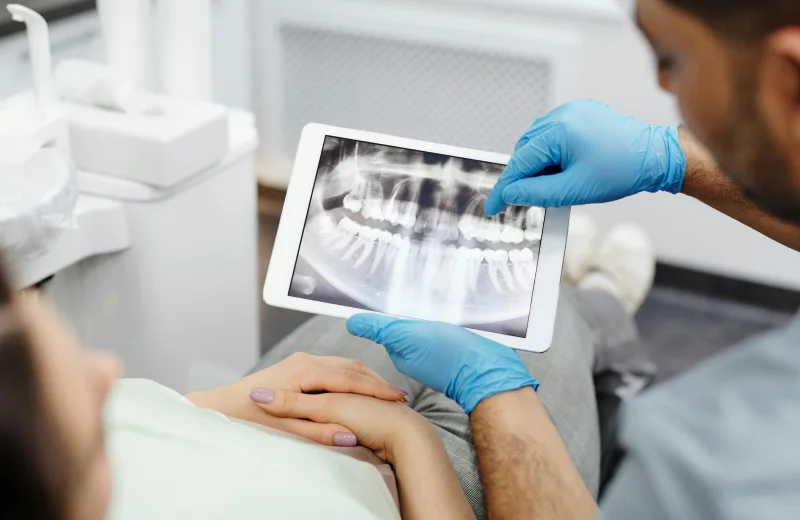
Then an OPG, the wide panoramic radiograph that captures both jaws in one image. It shows the angle the tooth is lying at, how many roots it has and how curved they are, the bone around it, decay in the wisdom tooth and on the back of the second molar, any cyst, and where the inferior alveolar nerve canal runs relative to the root tips. That last detail changes the plan more than anything else.
Treatment for acute pericoronitis is mechanical: irrigating under the flap to flush the pocket out, debriding it, and where the upper wisdom tooth is chewing the swollen gum, adjusting or removing that tooth so the flap can settle. An abscess is drained. Relief is often noticeable within hours, because the pressure was what hurt.
The definitive options, including leaving the tooth alone
Once the acute episode settles there’s a decision to make, and one of the four honest answers is to do nothing.
• Removal, where there have been repeated episodes, where decay can’t be restored, where the tooth is damaging the second molar, or where there’s a cyst. The risks I go through beforehand: bruising, swelling for several days, jaw stiffness, dry socket and, for lower teeth near the nerve canal, temporary or (rarely) lasting altered sensation in the lip and chin.
• Operculectomy, removing the gum hood, where the tooth is upright and has room to come through fully. It doesn’t always hold; the gum can grow back over.
• Restoration, where the decay is accessible and the tooth is worth keeping. Root canal treatment on a third molar is possible but a case by case judgement, since the roots are often curved and access is awkward.
• Monitoring, where the tooth is fully through, upright, cleanable and causing no symptoms. Keeping an eye on it at a check-up and clean is often the right call. Routine removal of trouble-free wisdom teeth isn’t standard practice: neither the Australian Dental Association’s patient guidance on wisdom teeth nor healthdirect’s describes it as a precaution, and both list problems, present or at real risk of developing, as the reason to operate. No problem, no operation.
What this costs depends on which of those you need, from an urgent assessment and drainage through to surgical removal, and I can’t give a figure before I’ve seen the tooth. If it does turn into surgical removal, the payment plan arrangements here spread that over time, with conditions that apply. Don’t let money set the timing; an infection gets more involved the longer it runs.
When I refer you to a surgeon, and when I send you to hospital
I’m a general dentist. I take wisdom teeth out here where the tooth is accessible, the roots are a sensible shape and the whole thing can be done under local anaesthetic alone. I refer to an oral and maxillofacial surgeon when the tooth is deeply impacted in bone, when the roots sit against the inferior alveolar nerve canal, or when someone needs sedation or a general anaesthetic. That isn’t a bad sign; it’s how the risk to the nerve is kept as low as it reasonably can be.
Deep neck infection is a different matter. I don’t manage it and I don’t operate in hospital. If you arrive with a firm swelling in the floor of your mouth, my job is to get you to an emergency department fast, not to start treatment.
After the tooth comes out
Swelling usually peaks around day two or three, then eases. Pain climbing after day three isn’t normal healing. Watch for dry socket, where the clot breaks down and leaves bone exposed, typically two to four days afterwards as a sharp increase in pain radiating to the ear. Smoking, straws and vigorous rinsing in the first day all raise the risk. It settles with treatment, but it needs a visit rather than more painkillers.
Questions people ask at 2am
How long does a wisdom tooth infection last? An untreated flare-up builds over two or three days and grumbles on for a week or more. With treatment most people feel a clear difference within a day or two.
Can I fly with an infected wisdom tooth? Get it assessed before you travel. Cabin pressure changes can increase pain in an infected tooth, and one that deteriorates mid-flight, or somewhere you have no dentist, is a bad place to be.
I’m pregnant and I have a wisdom tooth infection. What should I do? Get seen, and tell the practice you’re pregnant when you book. An untreated infection generally carries more risk in pregnancy than treating it does. Necessary treatment, including local anaesthetic, is routinely provided, and radiographs are taken only where they change the decision, with shielding. Elective work such as whitening during pregnancy can wait; an infection can’t.
Should the other wisdom teeth come out at the same time? Not automatically. Each tooth is judged on its own x-ray and its own history. The upper tooth on the same side sometimes comes out because it’s biting into the flap and keeping the problem going, but a wisdom tooth that’s through, upright and cleanable stays.
If the back of your jaw is swollen and you’re in the Inner West
Call us on (02) 9747 6835 for an urgent appointment, or book online if it’s after hours and you’re not in the emergency category. Suite 1, Level 1, 28 Burwood Road, Burwood NSW 2134.
And if you’re reading this at 2am with any of the red flags from the top of the page: hospital, now. The tooth can wait.
References
1. Brizuela M, Daley JO. Oral Facial Infection of Dental Origin: A Guide for the Medical Practitioner. StatPearls, NCBI Bookshelf, National Library of Medicine; last updated August 2025. https://www.ncbi.nlm.nih.gov/books/NBK542165/
2. healthdirect Australia. Mouth and teeth (wisdom teeth section). https://www.healthdirect.gov.au/mouth-and-teeth
3. Australian Dental Association. Wisdom Teeth, teeth.org.au. https://teeth.org.au/wisdom-teeth
4. healthdirect Australia. Symptom Checker. https://www.healthdirect.gov.au/symptom-checker
This article is general information about infected wisdom teeth, written for an Australian audience. It can’t tell you which of the three infections you have, how close your roots sit to the nerve canal, or whether your swelling is spreading; those questions need an examination and usually a radiograph. It is not a substitute for assessment by a registered dental practitioner, nor for emergency medical care. If you have difficulty breathing or swallowing, a change in your voice, swelling under the tongue or into the neck, or a high fever with feeling very unwell, call 000 or go to a hospital emergency department.